How to enjoy your Thanksgiving meal with Dysautonomia and MCAS
Which pattern is yours, and the small kitchen changes our family makes
This Thanksgiving issue comes in two parts. First, Dr. Rani Gandham explains why the holiday meal can make you symptomatic, and the small changes that help. Then read on for a guest section from her daughter-in-law, Jessica Tenuta about her Dysautonomia-friendly brined turkey, low-fat gravy and all the swaps that keep our family’s symptoms calm on Thanksgiving.
By Dr. Rani Gandham, MD, medical director of Hypermobility Medicine
The short answer: When the holiday meal goes wrong, it usually goes wrong in one of three ways: a slow stomach, a mast cell reaction, or gut bacteria fermenting certain carbohydrates. Each one is different and calls for different changes. You don't have to skip the meal. For most people, a few small changes matter more than avoiding whole dishes.
Every year after Thanksgiving, I hear how much our patients feel they have to choose to either not eat what others are eating, or get flared up. Knowing which pattern of symptoms you have tells you what to swap for the meal, and most of those changes still leave room for the foods you love.
Full and nauseated for hours?
That points to gastroparesis, a stomach that empties too slowly.¹ You fill up fast or stay full for hours, with nausea, belching or upper belly pain.² Fat and texture are the usual triggers: gravy, buttery sides, pie crust, turkey skin, and anything hard to chew well.³
What helps: Start with a smaller plate and go back later if you want more. Choose lean turkey and lighter versions of the rich sides, chew well, and favor softer textures.³
Nothing is physically blocking the stomach.¹ Texture matters as much as fat: in a trial of 56 people with gastroparesis from diabetes, a diet of soft foods with small particles eased nausea, fullness and bloating.⁴
Flushing, itching or a racing heart?
That points to mast cells, immune cells that release histamine, the chemical behind flushing and itching. In mast cell activation syndrome (MCAS), they release it too easily.⁵ A reaction can hit several systems at once: flushing, hives, a racing heart, wheezing, cramping or diarrhea.⁶ It can come on fairly soon after eating. At a holiday meal, the common culprits are older leftovers, aged cheese, cured meats and wine.⁷
What helps: Refrigerate leftovers within two hours, and eat or freeze them within a day or two, since histamine builds as food sits.⁷ Go easy on aged cheese, cured meats and alcohol.⁷
Why those foods? Histamine builds in meat and fish as they lose freshness, and it runs high in aged cheese, cured meats and fermented foods. Alcohol can make histamine reactions worse, and wine is one of the higher-histamine drinks.⁷
Bloated and gassy by evening?
That points to SIBO, small intestinal bacterial overgrowth, something that can happen downstream of : too many bacteria in the small intestine.⁸ They ferment FODMAPs, carbohydrates the gut can't fully absorb.⁹ Gas, bloating and lower belly discomfort can build over the hours after a meal, sometimes with bowel changes.⁸ The usual triggers are onion and garlic in everything, wheat rolls and stuffing, beans, creamy dishes and some fruits.⁹
What helps: Go lighter on the onion- and garlic-heavy dishes and the stuffing rather than cutting them out.⁹ The carbohydrates in garlic don't dissolve into oil, so garlic-infused oil, with the pieces taken out, keeps much of the flavor.
Slow movement through the gut is one cause of SIBO.⁸ When bacteria ferment FODMAPs, they make gas and pull water into the bowel, which stretches it and causes the bloating and discomfort.⁹
What if I have POTS too?
Hypermobility, POTS (a form of dysautonomia, trouble with automatic functions like heart rate and blood pressure) and MCAS often travel together.⁶ If you have POTS, a big meal, a hot kitchen and long stretches of standing all strain blood flow, which can leave you dizzy and wiped out.¹⁰ Smaller portions, with seconds later if you want them, are usually easier than one big plate. Sit when you can, step out of the kitchen, and follow the plan your doctor gave you for big days, whether that's fluids and salt or a rescue medicine.¹⁰
Slow stomach emptying may also be more common in people with hypermobility and POTS than in the general population.⁶
If flushing or hives come with throat swelling, trouble breathing or feeling faint, treat it as an emergency and get care right away.
How do I figure out which one is triggering me?
Write it down the same day. "I felt awful after dinner" is a starting point. "Full and nauseated for hours after the gravy" is a clue your doctor can use.
A simple log to bring to your doctor (screenshot this):
Time you ate, and roughly how much
What was on the plate (rich, chunky, leftovers and how old, onion or garlic, wheat, beans, dairy, alcohol)
When symptoms started and how long they lasted
What you felt, and where
Anything else that day: heat, standing, poor sleep, stress
One gentle warning: please don't cut whole food groups because of this article. Eating should not start to feel scary, and restrictive diets need professional guidance.⁶ Change one thing at a time. And if a relative comments on your small plate, you can simply say, "I'm pacing myself so I can enjoy the whole day with you."
Now for the part you'll want to save: how Jessica actually cooks Thanksgiving for our family.
How we cook Thanksgiving for our family
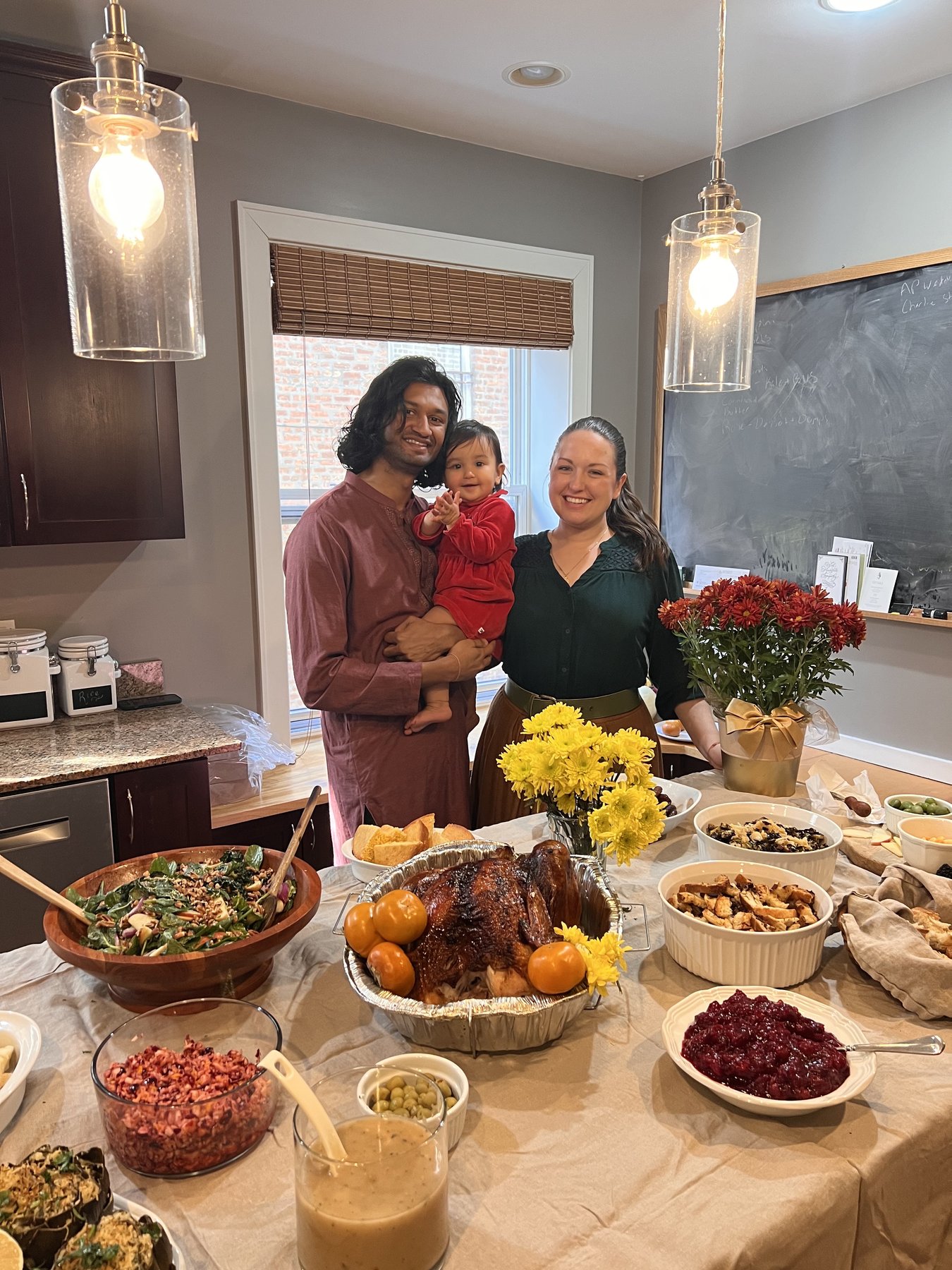
Our family at a past Thanksgiving.
A guest section by Jessica Tenuta, Dr. Rani Gandham's daughter-in-law, Kasey Gandham's wife, and mom to their daughter, Tala.
Everyone at our table eats a little differently but we always find ways to fully enjoy and celebrate every holiday with wonderful food. We like to think of ways to find simple swaps and adjustments that keep everyone’s tummies happy, without anyone missing out on the joy of celebrating with their favorite dishes. I'm dairy- and gluten-free. My husband and our daughter do fine with gluten, but a lot of fat doesn't sit well with them because of dysautonomia and gastroparesis. So I don't cook separate meals. I cook one Thanksgiving with small changes that work for all of us, and nobody feels like they're missing out. My biggest secret to cutting fat is leaning on herbs for flavor instead.
The turkey. A lot of people butter their turkey a lot. We brine ours instead, which adds no fat, and it's one of my biggest tips for a delicious dysautonomia-friendly turkey. I also give my husband and daughter breast over dark meat and go light on the skin, for less fat.
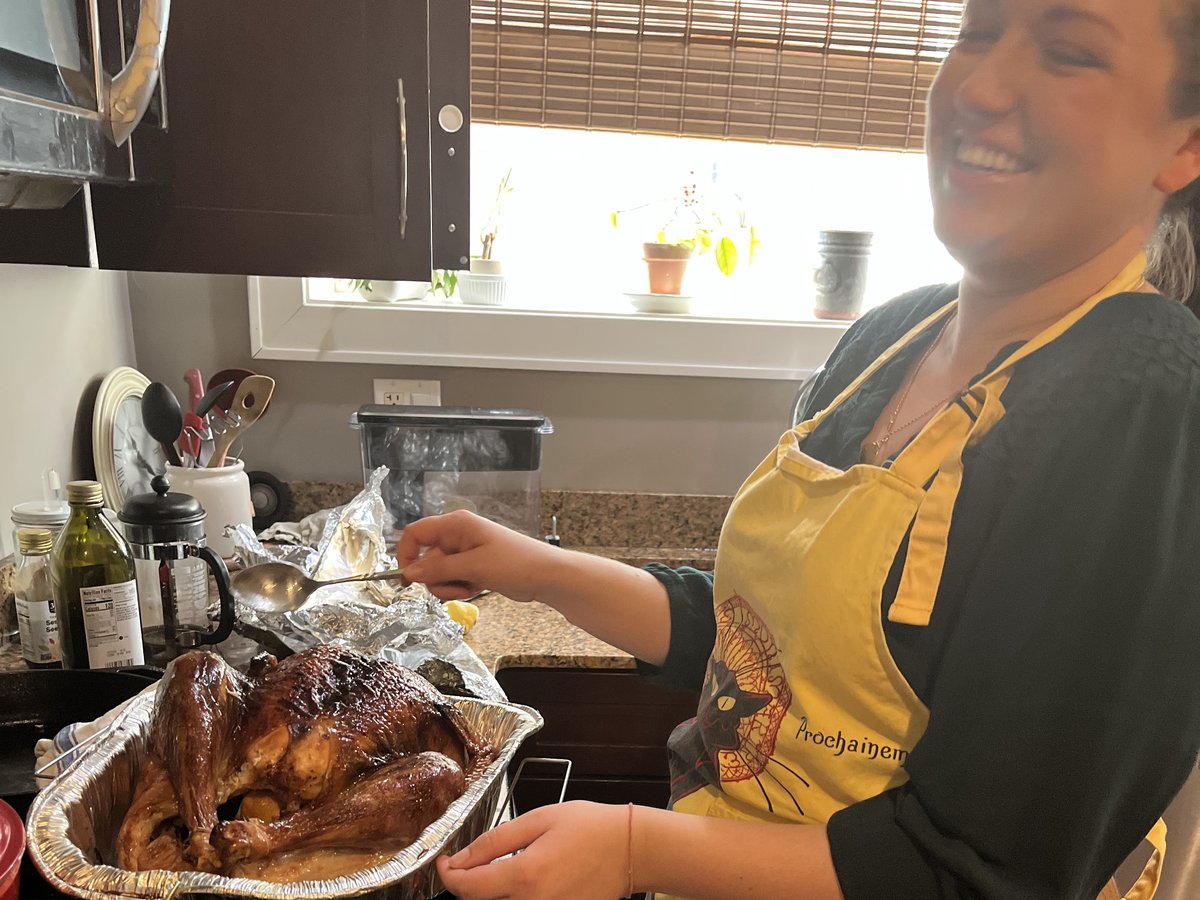
Jessica with the turkey at a past Thanksgiving.
How we brine:
Dissolve 1 cup kosher salt (or ½ cup table salt) and ½ cup of brown sugar per gallon of water, and add herbs like sage, thyme and rosemary, plus cloves, star anise, and pepper, if you like. If you can tolerate citrus, boiling the brine with the peel of two orange adds lovely brightness.
Cool it completely, then submerge the turkey and keep it in the fridge (or a cooler kept cold with ice) for about 12 to 24 hours for a whole bird, less for a breast.
Lift it out of the brine, discard the brine, and pat it dry. Then roast as usual, with no butter needed.
Skip brining if your turkey is already labeled kosher, pre-brined or "enhanced," since it's already salted.
Another bonus: aside from keeping the turkey more moist and soft (good for gastroparesis!), brining makes the whole meal more savory and salty, which tends to suit our family, since several of us run low blood pressure. If your doctor has told you to limit salt, check with them before you brine.
The gravy. Ours starts with broth instead of fat and gets thickened at the end.
2 cups turkey or chicken broth
About 1 teaspoon each fresh sage, thyme and rosemary, chopped (or ½ teaspoon each dried)
One thickener, whisked into ¼ cup cold water or cold broth until smooth: 2 tablespoons cornstarch, 3 to 4 tablespoons all-purpose flour, or 3 to 4 tablespoons gluten-free flour
1 or 2 tsp of olive oil
Salt and pepper to taste
Fry the herbs in a tiny bit of olive oil, about a teaspoon, to help them release their flavor.
Add the broth and Simmer with the herbs for about 5 minutes.
Whisk in the thickener slowly, and keep whisking as it simmers. Cornstarch thickens in a minute or two; flour needs about 5 minutes so it doesn't taste raw.
Season with salt and pepper, and strain out the herbs if you like it smooth. Makes about 2 cups.
If you want pan drippings for flavor, pour them through a fat separator and add only the juices.
Garlic flavor without the garlic. Garlic brings on SIBO symptoms for some of us, so I warm sliced garlic in oil and then take the garlic pieces out completely, retaining only the garlic-infused oil which gives my family the flavor without the flare up from eating garlic pieces. Make it fresh the day you cook, and keep any extra in the fridge for no more than a few days. I still keep the oil moderate, since too much fat is hard on a slow stomach.
The stuffing. This is the key one: as little butter or oil as you can get away with. I bake my own bread cubes from French bread (or gluten-free bread) until they're dry, then use just a little oil. Making our own bread cubes has been very helpful for my family, as the store bought ones are much harder and denser, which can be hard on gastroparesis. I go lighter on the onion and garlic and let the carrots, celery and herbs carry it.
The sides. Sweet potatoes and carrots are easy to make with very little fat. I love to prep my carrots with fresh thyme, sea salt, a drizzle of olive oil, and honey (if you tolerate honey well). Bake until the sugars carmelize .
Dessert. We make pumpkin bread and banana bread instead of pie. Our daughter doesn't do well with refined sugar and fat together, which seems more like a mast cell thing for her. I make the pumpkin bread gluten-free and swap the butter or extra oil for applesauce, a little oil and a spoonful of organic mayo, which ends up around a third of the fat. I also use less sugar than the recipe calls for, about half as much, but never miss the full sweetness. We top it with fat-free frozen yogurt, but read labels: some brands have gums and fillers that bother people sensitive to mast cell triggers. Making our own is on my list.
If you remember one thing
Dysautonomia or a slow stomach: go lighter on dark meat, skin, butter and oil.
SIBO: go lighter on garlic and onion.
MCAS: keep leftovers fresh, and be mindful of the herbs or spices you react to.
Everyone is different, so pay attention to what works for you.
This year, pick one dish to make the lighter way and see how everyone feels.
Where to go from here. Please don't change your medicines or start an elimination diet because of this article. To see how we think about mast cells, dysautonomia and gut health together, and the order we work in, read our Treatment Options guide.
Sources
Camilleri M, Kuo B, Nguyen L, et al. ACG Clinical Guideline: Gastroparesis. Am J Gastroenterol. 2022;117(8):1197-1220. https://doi.org/10.14309/ajg.0000000000001874
National Institute of Diabetes and Digestive and Kidney Diseases (NIDDK). Symptoms & Causes of Gastroparesis. Last reviewed January 2018. https://www.niddk.nih.gov/health-information/digestive-diseases/gastroparesis/symptoms-causes
NIDDK. Eating, Diet, & Nutrition for Gastroparesis. Last reviewed January 2018. https://www.niddk.nih.gov/health-information/digestive-diseases/gastroparesis/eating-diet-nutrition
Olausson EA, Störsrud S, Grundin H, et al. A small particle size diet reduces upper gastrointestinal symptoms in patients with diabetic gastroparesis: a randomized controlled trial. Am J Gastroenterol. 2014;109(3):375-385. https://doi.org/10.1038/ajg.2013.453
Weiler CR, Austen KF, Akin C, et al. AAAAI Mast Cell Disorders Committee Work Group Report: Mast cell activation syndrome (MCAS) diagnosis and management. J Allergy Clin Immunol. 2019;144(4):883-896. https://doi.org/10.1016/j.jaci.2019.08.023
Aziz Q, Harris LA, Goodman BP, Simrén M, Shin A. AGA Clinical Practice Update on GI Manifestations and Autonomic or Immune Dysfunction in Hypermobile Ehlers-Danlos Syndrome: Expert Review. Clin Gastroenterol Hepatol. 2025;23(8):1291-1302. https://doi.org/10.1016/j.cgh.2025.02.015
Comas-Basté O, Sánchez-Pérez S, Veciana-Nogués MT, Latorre-Moratalla M, Vidal-Carou MC. Histamine Intolerance: The Current State of the Art. Biomolecules. 2020;10(8):1181. https://doi.org/10.3390/biom10081181
Cleveland Clinic. SIBO (Small Intestinal Bacterial Overgrowth). Updated August 9, 2024. https://my.clevelandclinic.org/health/diseases/21820-small-intestinal-bacterial-overgrowth-sibo
Gibson PR, Shepherd SJ. Evidence-based dietary management of functional gastrointestinal symptoms: The FODMAP approach. J Gastroenterol Hepatol. 2010;25(2):252-258. https://doi.org/10.1111/j.1440-1746.2009.06149.x
Hypermobility Medicine. Treatment Options for EDS, POTS and MCAS (dysautonomia and mast cell sections). https://hypermobilitymedicine.com/approach/eds-treatment-options
Medical disclaimer: This newsletter is general education from Hypermobility Medicine. It isn't personal medical advice, and it doesn't replace care from your own doctor. Don't start, stop or change any medicine or diet based on it. If flushing or hives come with throat swelling, trouble breathing or feeling faint, get emergency care right away.
About Hypermobility Medicine
Gandham Family Hypermobility Medicine was built by a family with three generations living with hEDS. The practice is led by medical director Dr. Rani Gandham. We treat hypermobility and the conditions that often come with it, including POTS and dysautonomia, MCAS, GI issues and chronic pain, in one coordinated plan under one roof. We are also experienced hypermobility rehab practitioners. Care is by telehealth anywhere in New York or Connecticut (you need to be in one of those states during each visit), or in person at our office near Albany, New York.